


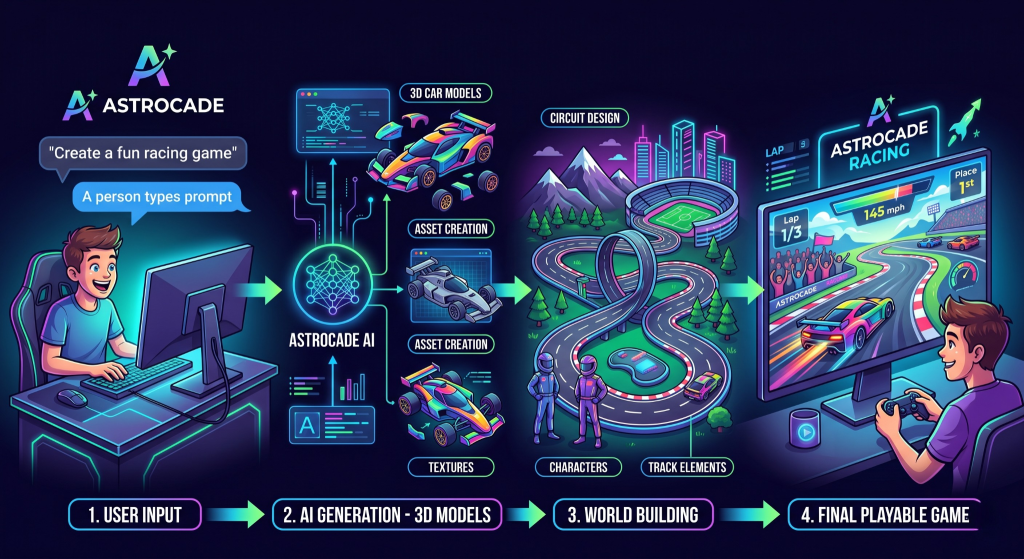
Many creators dream about reaching a huge audience, but the smarter goal is to create a game that people understand fast, enjoy quickly, and want to play again. A project does not reach millions of plays only because it looks nice. It usually grows because the first action feels clear, the challenge is easy to grasp, and the replay reason is strong. On Astrocade, a beginner can start with a small idea and shape it into something worth sharing by focusing on the player’s first minute, not by adding too much too early.
Why a game builder can help you design for repeat play
A game builder helps creators test the parts that matter before the project becomes too large. This is useful because big audience growth often starts with a simple loop. The loop is the repeated action that keeps someone playing. It might be to aim, attack, survive, collect, upgrade, dodge, or solve. If that loop feels good, the project has a better chance of keeping attention.
To make your own game with repeat play in mind, you need to think about what happens after the first attempt. Does the player feel they can do better? Do they understand why they lost? Do they want to improve their score, reach a harder stage, beat a rival, or unlock something new? A project that gives people a clear reason to return has more growth potential than one that only looks interesting for a few seconds.
Start with a hook people understand right away
A hook is the simple reason someone clicks, plays, and remembers your project. It should be easy to explain in one sentence. If the idea needs a long description before it sounds fun, it may be too unclear for quick growth. Strong hooks are usually direct. They promise speed, skill, danger, choice, survival, strategy, or a satisfying win.
Before using an AI game maker, test your hook with these checks:
- Can someone understand the idea in less than 10 seconds?
- Does the first action happen almost right away?
- Is the goal easy to see without a long guide?
- Does the challenge create pressure without feeling unfair?
- Can the player improve after each try?
- Is there a clear reason to replay?
- Does the project have one moment people may want to share?
- Can the first version work without too many features?
- Does the title match what the player actually does?
- Is the strongest part visible early?
Build around the first minute
The first minute is one of the most important parts of any project. This is where the player decides if the experience is worth more time. A slow start can hurt even a good idea. A confusing start can make people leave before they reach the fun part. A strong start gives one clear action, one visible goal, and fast feedback.
Think about what the player sees first. Do they know what to do? Do they feel in control? Does the project respond when they act? Do they get a small win or clear challenge quickly? These details matter because a large audience will not wait for hidden fun. The experience should show its value early. Once the first minute feels strong, later features have a better base to stand on.
About Tankor Arena
Tankor Arena is a combat arena project where the player controls tanks and fights waves of enemies or other players in battle zones. The idea has strong growth potential because it can start with simple movement, aiming, shooting, and survival pressure. A creator can shape the first version around clear tank control, visible enemy threats, short battle rounds, weapon feedback, and score-based progress, then later improve it with stronger waves, arena layouts, upgrades, rival pressure, and better combat pacing.
How a no-code game maker supports fast testing
A no-code game maker helps creators test ideas without getting slowed down by technical setup. Fast testing matters because no creator can fully predict what players will enjoy. You may think one feature is the best part, but real users may respond to something else. A quick draft gives you proof. It shows what feels clear, what feels slow, and what needs to be changed.
Use this testing checklist before you publish:
- Play the first version from a fresh user’s point of view.
- Check if the main action is clear in the opening.
- Make sure the goal appears early.
- Test if success feels rewarding.
- Test if failure feels fair.
- Watch if the first challenge arrives too soon or too late.
- Remove anything that slows the first minute.
- Improve feedback after important actions.
- Keep the strongest part easy to reach.
- Share with a small group before expanding the idea.
Design for one more try
A project that gets many plays often has a strong “one more try” feeling. This means the player fails, learns something, and wants another attempt. That feeling can come from close losses, visible progress, better timing, score goals, harder waves, unlocks, or smarter choices. The key is fairness. If failure feels random, the player may leave. If failure feels understandable, the player may try again.
To support this, show the player why they lost and how they can improve. If they missed a target, make the miss clear. If they ran out of time, show the timer. If they got trapped, make the danger visible. When the player understands the result, replay feels meaningful. They are not just repeating the same thing. They are trying to do better.
How to build a game people want to share
To build a game that spreads, you need a clear shareable moment. That moment might be a tough round, a funny failure, a close win, a high score, a smart strategy, or a surprising challenge. People share experiences that are easy to explain. If your project has a moment that can be shown in a short clip or described in a quick message, it has a better chance of reaching new users.
The best shareable moments usually come from clear design. The player understands the risk. They know what success looks like. They feel the pressure. When they win or fail, the result feels worth talking about. You do not need to force attention with too many effects. A clean challenge, strong timing, and clear feedback can create a stronger reaction than a crowded screen.
Making games for a big audience requires simple choices
Making games for a big audience does not mean making the project basic. It means making the entry point simple. Players should be able to understand the first action quickly. After that, you can add depth. This balance is important. Simple to start, deeper to master.
A good project can have easy controls but hard decisions. It can have simple rules but rising pressure. It can have a short round but long-term improvement. That kind of design helps both new and returning players. New players can start without confusion. Skilled players can stay because there is room to improve. This is often where stronger replay value comes from.
Improve what players already enjoy
After testing, do not guess blindly. Look for the part that players respond to most. Maybe they enjoy the speed. Maybe they like the challenge. Maybe they repeat one level. Maybe they care about upgrades. Maybe they enjoy beating their own score. That reaction tells you where to focus.
Do not add random features just to make the project look bigger. Bigger is not always better. If one part is already working, improve that part first. Make the feedback clearer. Make the pacing sharper. Make the challenge fairer. Make the reward easier to notice. A focused improvement can do more for growth than a large update that adds confusion.
A project that reaches many plays usually has a clear hook, fast action, fair challenge, strong feedback, and a reason to return. You cannot control every part of audience growth, but you can control the quality of the first experience. Start small. Test early. Watch real reactions. Improve the parts that people already enjoy. That is the practical path toward building something with real reach.
Astrocade gives creators a faster way to create game ideas, test first versions, and improve them through feedback. Focus on a clear hook, a strong first minute, and a replay loop that makes people want another try. Millions of plays may sound like a huge goal, but it starts with one simple question: does the first version give people a reason to keep playing?
