


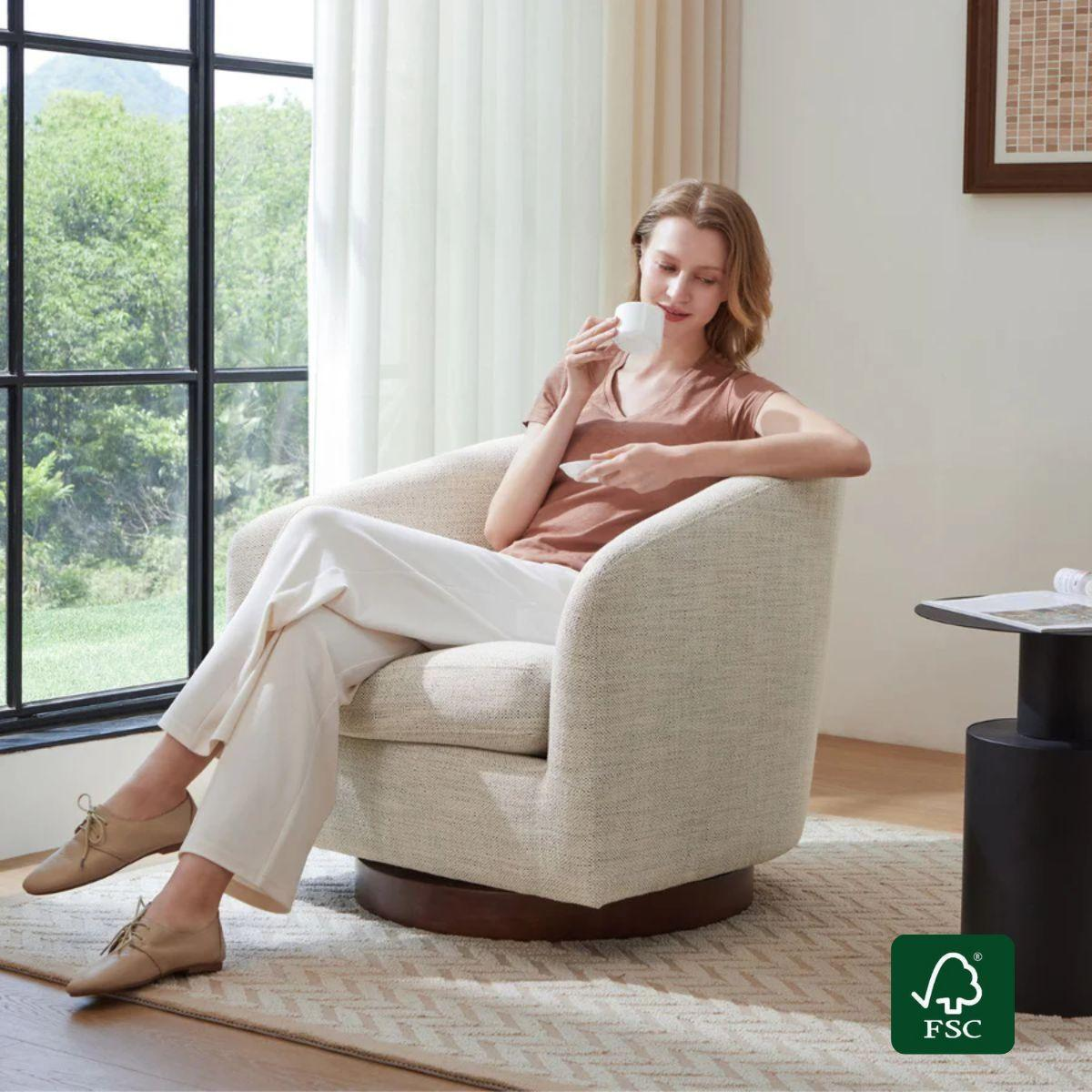
There is a particular kind of room that resists most furniture: the corner of a bedroom that needs a reading spot, the patch of living room beside a window, the spare nook that is too small for a sofa and too large to leave empty. A fixed chair placed in these spaces only works from one angle. Turn it toward the window and it faces away from the conversation; turn it toward the conversation and the light falls behind your shoulder. The result is furniture that looks correct in a photograph and feels wrong in daily use.
A grey swivel chair sidesteps the whole problem. The base stays where you put it, but the seat turns, so the same chair can face a window in the morning and a sofa in the evening without being dragged across the floor. Grey, meanwhile, is the rare upholstery colour that behaves like a neutral in almost any palette, warm or cool, dark or light, without disappearing into the walls.
This article looks at why the combination works so well in compact rooms, how to position it, and what to check before you bring one home.
The Case for Rotation in a Small Space
Most seating is designed for one orientation, which is fine in a large room where a chair can be surrounded by open floor. In a small room, orientation is the whole game. A chair that only faces one direction can serve exactly one activity, and small rooms are usually asked to serve three or four: reading, conversation, a laptop, a view outside. Rotation is what lets a single piece of furniture answer to all of them.
Practically, a swivel base also removes the need for clearance behind the chair. A fixed armchair has to have space behind it to allow someone to pull it back when sitting down or shifting position. A swivel model needs only enough room for the base, because the seat turns within its own footprint. In a corner where every inch counts, that saved arc of floor is often what makes the difference between a chair that fits and one that does not. A grey swivel chair compounds the advantage, since the colour keeps it visually quiet while the mechanism keeps it functionally busy.
One Chair, Several Functions
Consider how a single swivel chair can serve a small apartment across a day. In the morning it faces the window for ten minutes of quiet before work. Through the afternoon it turns toward a small desk or a side table to hold a laptop and a mug. In the evening it swings back toward the sofa so it becomes part of the seating group rather than an outsider. No other single chair type covers that range without either being moved or being left in a position that only suits one moment of the day.
This flexibility also helps when guests arrive. A swivel chair can be rotated outward to join the conversation and back again once the room empties, which means a small living area does not need a second armchair that would crowd the floor the rest of the week.
Small Footprints, Full Comfort
Swivel chairs are often assumed to be compact because the mechanism is associated with office seating, but the real reason they work in small rooms is the shape of the base. A round or compact pedestal concentrates weight under the seat, so the legs do not splay into walkways the way a wide four-leg frame can. That leaves more clear floor around the chair, which matters when the piece sits near a doorway or along the only route to the kitchen.
Comfort does not have to be sacrificed for that compactness. A well-built swivel chair can carry the same cushioning and back support as a fixed accent chair, with the difference hidden in the base. The point to watch is the height of the seat relative to the side table or ottoman you plan to pair it with; a swivel chair that sits too low will make every reach downward feel awkward, so check that relationship before committing to a position in the room.
Reading Grey as a Colour, Not a Default
Grey gets dismissed as the safe choice, the colour people pick when they cannot commit. In practice, a grey chair is doing something more specific: it is finding the middle of the room’s tonal range so that it can sit beside strong colours and pale walls at the same time without fighting either. That is a harder job than it sounds, and not every grey does it equally well.
Warm and Cool Undertones
Hold a fabric swatch against a white sheet of paper in daylight and the undertone becomes obvious. A grey that leans slightly brown or taupe reads warm and will sit easily next to oak floors, cream walls, and brass accents. A grey that leans blue or green reads cool and pairs naturally with black metal, pale stone, and cool white walls. Pairing the wrong undertone is the most common reason a grey chair looks flat or mismatched, even when the quality of the fabric is high.
A useful trick is to match the grey to the largest hard surface in the room rather than to the sofa. If the floor is warm oak, a warm grey chair will settle in; if the floor is cool concrete or pale tile, a cooler grey will. When the room has strong colour elsewhere, such as a rust rug or deep green walls, a mid-grey chair holds the middle and lets the bolder elements speak.
Texture Keeps Grey From Going Flat
Because grey lacks saturation, texture becomes the feature that gives it life. A bouclé or nubby weave catches light unevenly and reads as soft and dimensional; a smooth woven fabric reads flatter but more tailored; a velvet or chenille holds shadow and looks deeper in the corners of the room. Choosing texture is therefore a way of choosing how prominent the chair will be. A highly textured grey chair becomes a focal point even though the colour is quiet, while a smooth grey chair recedes and lets artwork or a rug carry the room.
This is where a swivel chair earns its keep in a design sense as well. The visible base is usually a different material from the upholstery, and the contrast between fabric and wood, metal, or a woven shell gives grey a second dimension. A wood base warms the grey; a dark metal base sharpens it; a sculptural frame makes it feel more like a piece of furniture and less like a generic seat.
Placement, Pairing, and Everyday Use
Once the chair is in the room, its value comes down to where it sits and what sits near it. A swivel chair rewards a little planning more than a fixed chair does, because the whole point is the range of positions it can take.
Where a Swivel Chair Works Best
The best spot is usually near a corner or a window, with at least a foot of clearance on the side it turns toward. Leave the back of the base close to the wall or the end of a sofa; the seat will rotate out from there without needing rear clearance, which is the mechanism’s main practical gift. If the room has a natural pivot point, such as the gap between a sofa and a fireplace, that is an ideal location, since the chair can face either without being moved.
Pair it with a small side table or a floor lamp rather than a full coffee table. A side table gives the chair a purpose in every orientation, while a coffee table in front of it would fix it to one direction and defeat the reason for buying a swivel in the first place. Keep the floor beneath the base clear of rugs with deep pile, which can make rotation feel sticky and wear the mechanism unevenly.
Maintaining the Mechanism
Swivel mechanisms are simple, and most of what they need is prevention. Vacuum the area under the base every few weeks to keep grit out of the bearing, and check the screws or mounting plate once a season, since a chair that is turned dozens of times a day will eventually work fasteners loose. If the rotation starts to feel stiff or noisy, the cause is usually debris or a slightly loose mounting rather than a failure, and both are quick to fix.
The upholstery side is easier. Grey fabric shows dust and pet hair more than darker tones but hides stains better than pale cream, so a weekly brush or vacuum with an upholstery attachment keeps it looking even. Address spills promptly with a cloth dampened in mild soap, working from the outside in, and avoid soaking the fabric. Treated this way, a grey swivel chair holds its colour and its movement for years, which is what makes it a sensible pick for a room that has to work hard.
The Chair That Turns With the Room
Small rooms are not really short on space; they are short on options. Each piece has to earn its floor area by doing more than one job, and furniture that locks into a single position rarely manages that. A swivel chair earns its place by changing orientation instead of location, which is precisely the kind of flexibility a compact room needs.
Grey strengthens the case. It sits comfortably between bold colours and quiet walls, it accepts whatever texture the fabric brings, and it does not draw attention away from the details that should carry the room. Choose the undertone to match your floor, check the seat height against your side table, and leave a little clearance for the turn. Do that, and the chair becomes the piece you reach for at every hour of the day rather than a corner decoration.
